• HOME
  • REVIEWS
    • Books
      • Africa
      • Arabia
      • Asia
      • Eastern Europe
      • Latin America
      • South Pacific
      • USA & Canada
      • Western Europe
    • Other Media
      • Art
      • Film
  • EDITING SERVICES
  • ABOUT
    • Bio
    • Creative Writing
      • Clear Out the Static in Your Attic: A Writer’s Guide for Transforming Artifacts into Art
      • Polska, 1994
    • Artist Statement
    • Artist Resume
    • Contact
    • Events
    • Professional Portfolio
  • BLOGROLL

A Geography of Reading

"It is by reading novels, stories, and myths that we come to understand the world in which we live." -Orhan Pamuk

Chocolat, the Crone, and a Life Well-Lived

November 3, 2012 by Isla McKetta, MFA Leave a Comment

chocolat - joanne harrisSome nights I miss Baba more than I can bear. I’m surrounded by wonderful memories of my grandmother and I know she was ready to die. Still, although it’s been nearly two years since she passed away, the grief sneaks up on me. This happened recently as I encountered the character of Armande Voizin while reading Chocolat by Joanne Harris. This review contains spoilers…

Every Character Has an Arc

That every character should have an arc is common knowledge among writers—whether they abide by the rule or not. One of the things I love about Armande is that we encounter her at the end of hers.

I’ve written before of AS Byatt’s quote, “There is always an old woman ahead of you on a journey, and there is always an old woman behind you too, and they are not always the same.” Armande answered the question of primary motivation ages ago and each of the questions she is faced with throughout Chocolat is decided based on the person she became.

The Wisdom of Experience

Armande is the crone of fairytale and like any old witch, she developed a lot of wisdom along the way. She imparts this wisdom in gentle ways throughout the novel.

The wild Vianne Rocher who blows in on the wind and follows her own whims is in many ways a younger version of Armande. Vianne faces much opposition in the town, but the presence of Armande—who recognizes Vianne as a witch and proclaims herself one—shows Vianne and the reader that another life is possible even in the strict confines of a small town.

The wisdom Armande had to impart to me was acceptance. Like Baba, she lived a long, rich life, and at the end of the story, she is ready to leave the earth. Armande prepares a final feast (like my grandmother, Armande is diabetic and she has gone off her insulin), as a celebration. She is not coy about her purposes, but she does not tell everyone. She only tells those who have the life experience to understand her—Vianne who saw her mother’s health decline and Guillaume who let his ailing dog hold on too long.

Reading about this final banquet, I see how it could have been for Baba. The last time I saw her was at a weekend of parties with the whole family in attendance. It was my grandfather’s 95th birthday and their 65th wedding anniversary. She whispered something in my husband’s ear and I waved goodbye at the door. The grandkids gathered at the airport and toasted family and life.

Though I am grateful for every moment Baba was part of my life, most days I try to forget the last time I spoke with her. It was a few months later on my birthday and my aunt helped her make the call. We knew she was dying and it was wonderful to hear her voice, but it was awful to hear her incoherence and to know how long her body had been failing. She wasn’t the person I remembered and it scared me how scared she sounded.

Rewriting an Ending

BabaMost of us do not get to control the terms of our own exit, but I’m rewriting the story of Baba’s death. After that weekend of parties, she went home and ate a gallon of butter pecan ice cream. She snuggled up with her husband of 65 years and said goodnight one last time.

It’s an imperfect scenario. She would have missed the birth of her first great-grandchild—an occasion I’m certain gave her great joy—but she also would have been at peace. Maybe part of Armande’s wisdom of acceptance is that life is full of tradeoffs.

I am looking to Baba’s memory tonight for guidance on a comparatively trivial matter. I sit in my office surrounded by things that were once hers sipping wine from a glass that belonged to her mother. Maybe it’s time for me to take all the wisdom she tried to share over the years and find my own story arc.

Good night, Baba.

If this review made you want to read the book, pick up a copy of Chocolat from Bookshop.org. Your purchase keeps indie booksellers in business and I receive a commission.

Filed Under: Books, Western Europe Tagged With: acceptance, death, grief

A Geography of Greece with Fuschia Phlox’s Return to the Aegean

September 4, 2012 by Isla McKetta, MFA Leave a Comment

There are a myriad of things that make me fall in love with a story, but a strong setting has to be at the top of the list. A literary geography is comprised not just of the landscape where the story takes place but also of people their relationships with the location. Though Fuschia Phlox’s Return to the Aegean is well plotted, the rich characters and gorgeous setting are what captured my heart.

“There is such pleasure in taking from nature what wants to be taken.” – Fuschia Phlox

PHlox reaps the natural beauty of the Greek islands and sows it into the descriptions in this novel. From olive orchards to rocky shores, I wanted to move in with Thalia as she returns to the place she once called home. While Thalia explores the mysteries of her family’s past, the reader is treated to loving descriptions of Greek rituals of life and death.

I’m not always the most careful reader, but something about Phlox’s character descriptions makes it easy to differentiate between the large number of characters in the novel. The characters are believable and I found myself wanting to befriend Irini and Petros. I felt for Mina and I loved Sophia. Each new character seemed to have his or her place in the natural order of the island.

I appreciated that as wide as the focus of characters is, the narrative always returns to swimming and the sea. In fact, the gently insistent way Phlox consistently brings the book back to the theme reminds me of Anne Michaels.

Phlox has a knack for pacing. Each chapter leaves off with a gentle prod forward that kept me reading well past my bedtime. I don’t think I’m spoiling anything if I say the end unfolds like the denouement of a 19th century novel.

“You don’t listen until you are truly ready.” – Fuschia Phlox

This was my first experience reviewing a book from a PDF and the format affected the way I read the book. Because I am used to editing my own work onscreen, I found I had difficulty getting distance from this novel. As a result, I paid more attention to nitpicky things than I normally would when reading for pleasure. For example, the (albeit few) sentences that were overwritten really stuck with me. I also got hung up on the footnotes that defined the Greek words and kept thinking about editing context clues into the text instead. It seems I’m still a few years off from being ready to go the e-reader route.

Overall, I’d say that Return to the Aegean is the perfect mixture of a vacation book and a serious novel. You may think you are wholly engrossed with the mystery, but part of you will be checking flight times on the next plane to Greece.

If this review made you want to read the book, pick up a copy of Return to the Aegean from Bookshop.org. Your purchase keeps indie booksellers in business and I receive a commission.

Filed Under: Books, Western Europe Tagged With: book review, characterization, greece, setting

Creating a Dreamworld in Calvino’s Marcovaldo

August 5, 2012 by Isla McKetta, MFA Leave a Comment

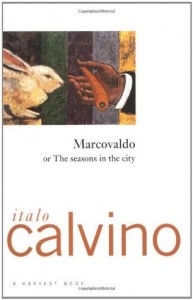
marcovaldo italo calvinoI sought out Italo Calvino this morning because I wanted to learn how he creates fairytales that seem to exist very close to reality. In the fourth story of Marcovaldo, “Winter, The City Lost in the Snow,” I found what I was looking for.

In the Beginning

Creating a dreamlike world starts with the first sentence: “That morning the silence woke him.” Yes, it is possible to be woken by silence, but it is also a clue to the reader that something out of the ordinary is happening. Then Marcovaldo senses “something strange in the air.” Calvino describes the character’s disorientation and the reader’s awareness of the strangeness deepens.

At this point, the reader is three sentences into the story and aware that the reality of this story is not the same day to day reality of the first three stories in the collection. In the fourth sentence (still in the first paragraph) the city disappears. Then the narrator describes what Marcovaldo sees “almost-erased lines, which corresponded to those of the familiar view.” Of course he could just be describing what a snowscape looks like, but because Marcovaldo found it magical, I found it magical.

As I read this first paragraph, the fantastic elements washed over me. I felt the story building, but the first three stories in the book had been so realistic that I didn’t realize what was happening to my attention until the middle of the second paragraph when I encountered the strange phraseology of “the snow had fallen on noises.” The phenomenon Calvino is describing is common—snow has a hushing quality—but the way he described it was so unusual that I was instantly intrigued.

Treading a Thin Line Between Fantasy and Reality

Even though Calvino pulls back toward the real, concrete world as he writes the almost scientific, “sounds, in a padded space, did not vibrate” he keeps Marcovaldo and me hovering between reality and fantasy. Calvino keeps Marcovaldo’s dream world present with language like, “who could say if under those white mounds there were still gasoline pumps, news-stands, tram stops, or if there were only stack upon stack of snow.” Even when Marcovaldo is put to work shoveling snow, his mind wanders and he imagines that with the snow “he could remake the city.”

Calvino did not disappoint me. I learned from this story that to create a story that exists in the borderlands between fantasy and reality, I have to set the scene very carefully. There is as much fantasy in the first paragraph of this story as there is in the rest of the paragraphs combined. Once that scene is set firmly, I am free to play back and forth between the two lands as long as the story laps back and forth between the two worlds.

Now to put it to use. Just as soon as I finish reading this book…

If this review made you want to read the book, pick up a copy of Marcovaldo from Bookshop.org. Your purchase keeps indie booksellers in business and I receive a commission.

Filed Under: Books, Western Europe Tagged With: book review, fantasy, Italian Literature

Peter Høeg Invents the Keyser Söze of Danish Dreams

July 28, 2012 by Isla McKetta, MFA Leave a Comment

The History of Danish Dreams - Peter HoegAs the title implies, The History of Danish Dreams is dreamlike. Even more so for readers like me who have a poor knowledge of Danish history. Peter Høeg does a masterful job of hovering in the space between fable and fact where story and truth lie and though I am curious about whether there is an underlying structure of verifiable events, I will not look them up because I don’t want the spell to be broken.

Part of the spell Høeg casts is that he is able to dance between what happened and what might have happened. This is especially evident as he deals with the young girl Maria and whether she is a model child or the leader of a gang of truants.

The Model Child

The reader already knows much about the strangeness of Maria’s parents by the time she is born. Høeg weaves information about her upbringing into her parents’ narrative and I got to know her before I realized that she too would become an important character.

Over a series of twenty pages I watched Maria grow into an unusually observant child with a stammer. I saw the conditions of her mother’s declining health and the contemporaneous decline of her neighborhood. I learned that she was close with her father. And then there is a brutality that Høeg mentions more than once without delving into. She is different, but still he calls her “the model child.”

Stepping Out of the Narrative

“From this point onward certain problems arise in writing Maria’s story: I would like to depict her as a coherent individual…but this proves to be impossible…History is always an invention; it is a fairytale built upon certain clues…These clues are pretty well established; most of them can literally be laid on the desktop…But these, unfortunately, do not constitute history. History consists of the links between them, and it is this that presents the problem…In the case of Maria Jensen…it is not possible…to cover all the gaps, not even roughly.” – Peter Høeg, The History of Danish Dreams

Høeg interrupts the fictional dream and begins telling two stories—the story of Maria as her parents know her and the story of a second child called “The Stutterer” who could well be Maria. The only link between the two stories is a series of what must be truancy letters from her school. Truly compelling are the strong yet unprovable parallels between Maria and the Stutterer.

As Høeg tells more and more stories of the gang Maria is ostensibly the head of, he continues to use phrases like “It has not been possible for me to have a word with any of the individuals who then belonged in this group” and “we have no witnesses.” Had Høeg laid out evidence that Maria was the Stutterer, the story would have been about a girl who went bad and her parents never even knew. Because Høeg focuses on the gaps, though, and allows for the ambiguity, the story becomes a legend.

By the time Høeg finishes young Maria’s tale, the seven- or nine-year-old (we don’t even know her actual age) Maria has become the Keyser Söze of Denmark. Høeg seems in awe of her. The extent of her exploits could only be understood in the kind of exaggerated rumor that conveys the fullest truth possible but could never be understood in something as rigid as a court of law.

I am interested in exploring the ambiguous experience of a character in the novel I am working on now. I have been looking for a way to convey contradictory yet complementary information. I’m not sure yet if I want to pull the metafictional card by interjecting as a narrator, but I have a lot to learn from Høeg in terms of opening up the story to create a richer experience.

As with any book I read in translation and love, I know some of the credit is due to the translator. My thanks to Barbara Haveland for allowing me access to this book.

If this review made you want to read the book, pick up a copy of The History of Danish Dreams from Bookshop.org. Your purchase keeps indie booksellers in business and I receive a commission.

Filed Under: Books, Western Europe Tagged With: ambiguity, danish literature, metafiction

AS Byatt and Femininity in the Modern Fairytale

June 16, 2012 by Isla McKetta, MFA Leave a Comment

the djinn in the nightingales eye - as byattLately I’ve been drawn to fairytales and myths. Perhaps I am trying to recover an ebbing capacity for storytelling in my suddenly busy life, and perhaps I’m looking to get lost in the wonder of stories the way I did when I was a kid. Perhaps I’m missing afternoons at Louisa’s with Bob and Jack and their emphasis on the mythic journey. When I stumbled on AS Byatt’s The Djinn in the Nightingale’s Eye, I thought I wanted to read it because it spoke to the Arabian Nights, but what I fell in love with was the overall fairytale quality of the book and its five stories and what they told me about being a woman.

The Eldest Princess

In “The Story of the Eldest Princess,” the girl who goes on the quest to renew her kingdom is not the most beautiful of the sisters, she is the eldest. Sometimes it feels like our stories are only about the fairest of them all with the idea that everyone else is background. In this story, birth order is more important and princess status is not synonymous with beauty. The princess is not a victim of her fate and is rewarded for trusting her instincts. What I most liked is how the relationship between the crone and the princess spoke to a continuity of femininity and female knowledge that is too easy to ignore.

“There is always an old woman ahead of you on a journey, and there is always an old woman behind you too, and they are not always the same.” – AS Byatt, The Eldest Princess

The Djinn in the Nightingale’s Eye

There are many things to love about this story and how it portrays women. From the honest lustiness of Gillian (without the silly virgin tremble) to the unveiling of the desires of the Middle Eastern female. What I most loved was Gillian’s frank appreciation of her womanhood. When she is confronted with the opportunity to have anything she wants, she most wants to return to her body when she last liked it and that age is thirty-five. Perhaps this is vanity on my part as I am nearing that age and spend more time than I should worried about my “faults,” but I liked how the idea of a perfect female body is the body of a woman and not a girl. The djinn echoes this assessment. Though I do worry about the days after thirty-five and I hope I will continue to love my body as it follows the natural course.

“All love-making is shape-shifting—the male expands like a tree, like a pillar, the female has intimations of infinity in the spaces which narrow inside her” – AS Byatt, The Djinn in the Nightingale’s Eye

This book helped me appreciate myself as a woman. I loved that both the princess and Gillian are storytellers as I am. I hope my own stories will help future generations of women love themselves and to experience the infinite possibilities available inside the life the Fates assign.

If this review made you want to read the book, pick up a copy of The Djinn in the Nightingale’s Eye from Bookshop.org. Your purchase keeps indie booksellers in business and I receive a commission.

Filed Under: Books, Western Europe Tagged With: AS Byatt, book review, Fairytale, Fate, The Djinn in the Nightingale's Eye, Womanhood

  • « Previous Page
  • 1
  • …
  • 5
  • 6
  • 7
  • 8
  • 9
  • 10
  • Next Page »
  • Goodreads
  • RSS
  • Substack
  • Tumblr

Get New Reviews Via Email

My Books

Polska, 1994

Polska 1994

Clear Out the Static in Your Attic

Clear Out the Static in Your Attic_cover

Recent Posts

  • The Exquisite, Excruciating Details of Being Human in Flashlight, Thunder Song, and Kairos
  • The Depth of Simplicity in Beyond Where Words Can Go
  • bell hooks and Kim Hyesoon on Transgression and Creation
  • The Pure Power of Rage in The Bride by Maggie Gyllenhaal
  • Writing from the Margins in No Friend to This House

What I’m Reading

Isla's bookshelf: currently-reading

Birds of America
Birds of America
by Lorrie Moore
The Ecstasy of Influence: Nonfictions, Etc.
by Jonathan Lethem
The Souls of Black Folk
by W.E.B. Du Bois
Bomb: The Author Interviews
by BOMB Magazine
On Writing
On Writing
by Jorge Luis Borges

goodreads.com
Privacy & Cookies: This site uses cookies. By continuing to use this website, you agree to their use.

To find out more, including how to control cookies, see here: Cookie Policy
Content copyright Isla McKetta © 2026.