• HOME
  • REVIEWS
    • Books
      • Africa
      • Arabia
      • Asia
      • Eastern Europe
      • Latin America
      • South Pacific
      • USA & Canada
      • Western Europe
    • Other Media
      • Art
      • Film
  • EDITING SERVICES
  • ABOUT
    • Bio
    • Creative Writing
      • Clear Out the Static in Your Attic: A Writer’s Guide for Transforming Artifacts into Art
      • Polska, 1994
    • Artist Statement
    • Artist Resume
    • Contact
    • Events
    • Professional Portfolio
  • BLOGROLL

A Geography of Reading

"It is by reading novels, stories, and myths that we come to understand the world in which we live." -Orhan Pamuk

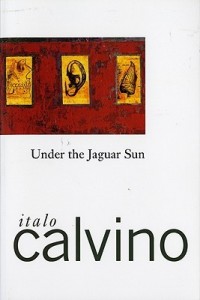
The Art of Writing: Under the Jaguar Sun by Italo Calvino

January 19, 2014 by Isla McKetta, MFA 4 Comments

Under the Jaguar Sun - Italo Calvino

There are a very few authors whose work I love so much that I covet and then hide their books away so I don’t read all of them at once. Italo Calvino is at the top of that list. So when my husband gave me Under the Jaguar Sun for Christmas, I thought I’d stumble on it some day in the future when I really needed a good read.

But something he said about the title story and love and adventure made me read the book just a few days later, and I’m so glad I did. I was performing final edits on two manuscripts at the time and if there is ever a time in a writer’s life that she needs a good book, it’s during those final edits when you think you’ve done everything you can to a book and need a little boost. I’ve always loved Calvino, but what he showed me in just a few pages made my work infinitely better.

Be warned: I’m going to spoil (a little) some plots in this review, but I don’t think that will take very much away from the pleasure of reading this book for the first time. If you’re worried, though, stop reading here and come back and chat with me when you’ve read the book. It’s only 86 pages so don’t be too long.

Writing for All Senses

This book was conceived as a series of stories that each focus on one sense. Although Calvino worked on it over a period of 13 years, he only completed three. I’m somewhat embarrassed to say I didn’t realize that was the conceit of the book until the end, but that also tells you a bit about how I surrender to Calvino and just let him do whatever he wants with my brain.

It’s not uncommon in writing workshops to draft a story that focuses on a sense. I wish I could do it as well as Calvino does and I love the way that his focus shapes the very nature of the story. “Under the Jaguar Sun” is a relatively traditional narrative about a couple visiting Mexico that focuses on taste. The story is gorgeous and well-written, which I’ll go into more in a moment, but it didn’t prepare me at all for “A King Listens.” That second story is a monologue told in second person to you, the reader, the king. The way the focus of the narration shifts from quotidian advice to implications of rumor that breed suspicion and paranoia is flat-out brilliant. It played with the fleeting nature of hearing and how we interpret the implications of what people tell us.

“Epigraphs in an undecipherable language, half their letters rubbed away y the sand-laden wind: this is what you will be, O parfumeries, for the noseless man of the future.” – Italo Calvino, “The Name, the Nose.”

The third story, “The Name, the Nose” captures the ineffable magic of scent as a man seeks to find the woman who so bewitched him with her perfume. The story plays with the power of our sense of smell to provoke memory and also the way that memory sometimes shifts as we recall it. The way the story unfolds is a huge part of the magic, so that I will not spoil here.

Showing Your Hand

The art of writing, in the hands of masters, is about manipulating the experience of the reader so the words you put on the page evoke what you want them to, even though each person brings his or her lifetime of connotations into their reading of it. Like a magician, one of the ways Calvino does this is by telling you what he’s going to do to you before he does it.

This is most obvious in “Under the Jaguar Sun” when the couple encounters Salustiano who becomes a sort of guide. The narrator describes him thusly:

“It was his way of speaking–or, rather one of his ways; the copious information Salustiano supplied (about the history and customs and nature of his country his erudition was inexhaustible) was either stated emphatically like a war proclamation or slyly insinuated as if it were charged with all sorts of implied meanings.” – Italo Calvino, “Under the Jaguar Sun”

Okay, that’s all a pretty cool description of character. But it’s also the key to what the narrator is interested in about the man and about what he’s just learned from this character and will soon try out on us.

“From one locality to the next the gastronomic lexicon varied, always offering new terms to be recorded and new sensations to be defined. Instead [of chiles en nogada], we found guacamole, to be scooped up with crisp tortillas that snap into many shards and dip like spoons into the thick cream (the fat softness of the aguacate–the Mexican national fruit, known to the rest of the world under the distorted name of “avocado”–is accompanied and underlined by the angular dryness of the tortilla, which, for its part, can have many flavors, pretending to have none)” – Italo Calvino, “Under the Jaguar Sun”

What Calvino is doing here, besides giving me a wicked craving for guacamole, is deconstructing the sensation of encountering these things so that they are new to us by calling attention to the renaming of the avocado. He’s insinuating that the things we encounter that seem bland–the tortilla chips–have a flavor and rich experience all their own. In the context of the story, this passage also has implications about how we fail to appreciate the flavors of our lovers.

Because Calvino is so adept at this sleight of writing, this manipulation expands and enhances the story for me. I enjoy it rather than bucking against it.

Repetition

A friend once told me that things need to be repeated seven times in a book for a reader to really catch on. I’m not sure if that same number holds for a short story, but Calvino definitely uses repetition as emphasis and he does it so subtly that you’re constantly re-encountering information without feeling like you’ve heard that all before.

In the case of “Under the Jaguar Sun,” some of the most powerful repetition revolves around Olivia, the narrator’s lover, and eating. At first he very carefully observes her eating, following as she chewed “the tension as it moved from her lips to her nostrils, flaring one moment, contracting the next.” Later, they are at a temple having just heard about human sacrifice and he focuses on her “strong, sharp teeth and sensed there a restrained desire, an expectation.”

The subtle repetition of theme slowly sinks in as you read, and the way Calvino handles eating, especially in relation to Olivia, evolves very quickly throughout the story. What it ultimately says about her relationship to the narrator made me glad this wasn’t the story of my relationship. But the story is very evocative and I think we’ve all been in that place at least once.

I’ll return to this book, as I plan to return to all my Calvinos, when I need that boost of writing excellence. Who are the writers who speak to the way you write and who teach you with every word they put on paper?

If this review made you want to learn from Calvino, pick up a copy of Under the Jaguar Sun from Bookshop.org. Your purchase keeps indie booksellers in business and I receive a commission.
Filed Under: Books, Western Europe Tagged With: Italian Literature, Italo Calvino, under the jaguar sun, writing

Red Horses and the Art of the Prequel

July 3, 2013 by Isla McKetta, MFA 5 Comments

Can you ever read a prequel for its own sake? Reading Red Horses by Donna Lynch, I knew it was a prequel for Lynch’s debut novel Isabel Burning and that it elaborates on the history of the Grace family. But having not read the other book, I was interested to see if Red Horses could be successful on its own merits.

Does the Book Stand on its Own?

The first few pages of the book are very compelling. You are introduced to Anastascia Millerovo, a “carrier of souls” days after her father’s death in Victorian London. She visits his attorney to find that she has inherited a large sum of money, her father’s journal, and a husband should she choose to accept the young Mr. Grace. I presume that’s where this book ties to Isabel Burning in that this is the origins of that family. It feels like Lynch chose for this prequel to go straight to the ancestry without mucking about interweaving this story with the last. I’m grateful for that, because it did allow me to read this book on its own, even though the fact that it is a prequel never left my mind.

Is the Writing Good?

Lynch creates some compelling characters in this tortured family saga. Much of the action of the book takes place inside Vladimir Millerovo’s journal as he meets and falls in love with Anastascia’s mother. But it’s not a simple love story and there is as much hate as there is love between the characters. It’s interesting to watch the lovers travel from hardship to hardship across Europe and eventually to the Caribbean. I did wish I got to know Anastacia more throughout the book, because the introduction to her was so compelling.

The description can be a little over the top sometimes with it’s magical moodiness, especially if you’re used to literary fiction, but it doesn’t go too far for my tastes and I enjoyed reading this type of book again for the way that magic opens up a world. Sometimes I even wanted it to be more magical and to really see what Anastascia’s powers could do.

And there were times when I wanted to slap Anastacia’s mother for not taking more control of her life, but it’s never fair to judge a Victorian woman’s circumstances by modern standards.

Will You Want to Read More?

Yes. I’m not quite sure how Isabel fits into this whole scenario. I did want to see if Anastascia’s powers develop more in Isabel Burning and now that I’ve read the backstory, I’m very curious to see where Lynch’s initial inspiration lay.

Red Horses will be released in August, so you have time to read Isabel Burning first if you want to, but it’s not necessary. The book is currently available for pre-order directly from the publisher.

Filed Under: Books, Western Europe

Escape and Learn with Crete: A Notebook by Richard Clark

June 2, 2013 by Isla McKetta, MFA 2 Comments

No matter what the weather where you live is telling you, summer is almost here. That means it’s time for vacation and at the very least a less onerous reading list. Crete: A Notebook by Richard Clark recalls the best of Peter Mayle. If I told you the book was a memoir/guidebook infused with mythology, history, and geology, I wouldn’t be doing the book justice.

Memoir of an Expat

Richard Clark first moved to Crete to teach in the 1980s and he’s returned time and again. What this does for the book is give a loving portrait through time of the people and places of Crete. He is both part of the culture and not and what could have been a guidebook turns into a personal story. Together with Clark, you get to experience the philoxenia, the kindness of welcoming strangers. He doesn’t tell you about how locals might buy you a drink or offer you water, he shares endearing stories about the many many times it’s happened to him all over the island.

Cretan Mythology

Woven into the narrative are reminders and retellings of your favorite Greek myths and where they happened. Zeus was born on Crete and hid here from his father, Kronos, before he overthrew him. He seduced Europa nearby and fathered King Minos. Remember the minotaur? You’ll feel the story come alive as Clark visits the remains of the palace where that story originated. I even learned some things about Icarus I didn’t know.

History of Crete

From Chania, a town that’s been inhabited continuously for 5,000 years to the ruins of a palace abandoned in 1900 BC, Crete has an incredibly rich history. The island has been under Byzantine, Venetian, and Ottoman rule and parts of The Odyssey are thought to have been set here. Clark does a nice job of summarizing how these waves of influence have shaped each location and the people at large. There’s even an essay at the end on the current Greek fiscal crisis.

Geology

No less turbulent than the politics, Crete’s geologic history has included a major volcanic eruption, a part of the island that’s sinking, and an upthrust that caused one major port to rise above sea level and become uninhabitable. Reading about these violent changes somehow made the island seem even more enticing to visit.

Travelogue

At it’s heart, this book is a travelogue and you’ll learn words like “ouzerie” (place that serves ouzo) as you salivate over goat salads and Greek coffees. Clark describes the unique aspects of town after town and somehow manages to not make it all repetitive. You’ll get to know local characters like Nikos Kazantzakis and Ross Daly. Clark even touches on a few of the surrounding islands including Santorini for good measure.

If you’re looking to finally plan a trip to Greece or just need to read about someplace else, try Crete: A Notebook. You’ll learn more than you can imagine and be entertained all the way through.

Filed Under: Books, Western Europe Tagged With: Crete: A Notebook, Richard Clark

The Quiet Menace of Inner China by Eva Sjödin

May 5, 2013 by Isla McKetta, MFA 2 Comments

inner-china-eva-sjodin-coverFrequent readers of this blog will know how much I appreciate spare language. Inner China by Eva Sjödin and translated from the Swedish by Jennifer Hayashida shows brilliantly just how much horror can be wrought with the sparest of language. The story of two small children who hide in the woods to escape sexual abuse is remarkably restrained. And therein lies the power of this poetry.

The Sound of Poetry

The narrator, the protector whispers to her mute sister:

Dark hard. — And quiet, I say. Not a word to Mother, not to anyone.
Get it.
Otherwise you are dead dead.

Those sentences take on the feeling of a heartbeat when you are so scared and small that the biggest sound in the world is your heart is pounding in your chest and your ears. The staccato two beats of “Dark hard,” “Get it,” and “dead dead” are so simple and so strong.

Words Rushing Together

Throughout the book, Sjödin takes what would normally be a list of items and removes the punctuation as in, “Nettles brushwood thistles grow down towards the river.” The cumulative effect of these run-on lists is the feeling of rushing and running away. There’s an immediacy and she uses it judiciously.

The Power of an Image

Sjödin also uses simple yet unusual images in Inner China. The narrator describes how she and her sister are “empty inside like carbonation.” A soda is usually a happy thing for a child and many delight in the fizzing and sparkle, but here she sees the other side of that and I wondered, worried, that something as simple as a soda pop was part of their torment. Though why I should cling to the idea of a soda among all the other pleasures of life these girls have foregone…

Quiet Menace and Denial

As much as I read about suffering and sadness, sexual abuse and rape are topics I usually avoid. It’s easy for the writer to slip into what I feel is description for the sake of titillation, and I just can’t bear it. Sjödin does none of that. She provides very little description of the acts. Instead, she builds a feeling of menace. Early in the book she writes, “There is someone who eats children eats children” and combines it euphemistically with “He sticks it to me on the sly.” It’s clear what is happening to these girls, but the language is pulled back just enough that I found myself denying what was happening for much of the book. This adds another layer I felt like I could have been the mother of those girls, refusing to see what was in front of me.

Know Your Recommender

I adore recommending books, it’s like sharing an intimate part of your soul, but I’m only just now learning to reach out to friends to create reading lists for me. Inner China was recommended by Gwendolyn Jerris, a gentle and poetic soul who is likely to hide the things that really hurt but will tell you the real truth if you ask her. Invaluable qualities in an artist and a friend. I asked Gwendolyn because I knew I needed something quiet that spoke loudly and boy did she deliver. Don’t wait as long as I did to start asking for what you need. Your fellow readers are wonderful resources and sometimes what scares you most is just the right thing.

The Importance of Difficult Books

I will not deny that this is a difficult book to read. In fact I wouldn’t recommend it to most people just for the sheer emotional impact of it. I’ve kept it nearby in my office in the days since reading the book I think because I knew it wasn’t done with me. And I wasn’t going to write about it for this blog, but it is a beautifully written book. And it’s important sometimes to read outside your comfort zone in order to stretch and grow as a writer. I am grateful that Gwendolyn trusted me enough as a reader to recommend this book. Writers like Grace Paley can show you how to unpack an image in a few spare words, but even she got shelved relatively quickly. I think I’ll be living with Sjödin on my coffee table for a good long while yet.

What books linger on your coffee table or next to your computer? What are they teaching you?

Filed Under: Books, Western Europe Tagged With: Eva Sjödin, Inner China, Poetry, Swedish Literature

Waiting for God with Simone Weil

April 14, 2013 by Isla McKetta, MFA 2 Comments

There is something enticing about the idea of a young girl who sees through religion and philosophy and straight to God. Perhaps I think so, anyway, because I always wanted to be such a girl—to understand this infinite universe. Enter Simone Weil. Though of Jewish heritage, she grew up in an agnostic home. Still, her writings on God in Waiting for God touched me much more deeply than those of St. Augustine.

Questioning

Weil so clearly believes in God and yet she cannot bring herself to join with the Catholic Church. She has great love and respect for the priest with whom she is corresponding in the book, but she cannot bring herself to give him what he most wants, which is to baptize her. I too grew up in an agnostic home. Answers are hard for me to trust and I don’t have a future as a philosopher, but questions help me find my own truths.

Weil was very keen on intellectual honesty and I wonder if that kept her apart from the faith she seemed to crave. At times she seems to thrive on that separation, and I wonder if her way of thinking would have changed had she not died so very young.

Inspiration is Everywhere

Waiting for God is a different sort of book than what I usually review here. Although Weil meant for the essays in the book to be published, the letters have a raw, searching emotion that feels less polished (even though the language is beautiful). I wonder if she would have edited down the letters if they had been published in her lifetime.

As much as I emphasize craft in the essays on this site, sometimes the first thing you have to do as an artist is follow your passions. There is ample time for craft, but without inspiration, you risk polishing the proverbial turd. Weil was a perfect read for me because the questions I ask myself offline are spiritual ones. There were times I agreed with her and times I didn’t, but the best moments are when she touched tangentially on something I’ve been grappling with subconsciously. Some of those are questions I haven’t even formed yet, but reading Weil and seeing how she wrestles with the same subjects opened me up to some of my own truths.

Books are amazing and I love them. But when you feel flat, sometimes you have to put down your book and either read something entirely different or do something different. You are an amazing vessel of creativity. Honor and fill that with a myriad of approaches to the subjects you love. I sat through a lecture on machine learning this week where I also saw glimmers of God.

The Language of Faith

Weil has a knack for little sentences with big meanings. In reading this book, I kept underlining and underlining her aphorisms, but even that wasn’t enough to feel like I was pulling her thoughts through my brain and soul in the way I wanted. I started writing sentences from the book and grouping like with like—repentance, distance, acceptance, center, and love—until I had a poem, what turns out is a cento. Here’s an excerpt of the rough draft:

(acceptance)
You do not refuse
to accept me
just as I am.
The capacity to give
one’s attention to a sufferer
is very rare thing, a miracle.

Never is a genuine effort
of attention
wasted.
I am tempted
to put myself entirely in your hands
and ask you
to decide for me. I was prevented
by a sort of shame.

Your charity.
You bore with me
for so long
with such gentleness.

And now that I’ve subjected you to my exercise in learning how to use line breaks, go read or do something that inspires you. I’m off to write that machine learning poem (which I will not make you read).

What are your go-to topics for inspiration? Do you prefer materials that help you question or ones that provide answers?

If you want Simone Weil to blow your mind, pick up a copy of Waiting for God from Bookshop.org. Your purchase keeps indie booksellers in business and I receive a commission.

Filed Under: Books, Western Europe Tagged With: inspiration, simone weil, spirituality, waiting for god

  • « Previous Page
  • 1
  • …
  • 3
  • 4
  • 5
  • 6
  • 7
  • …
  • 10
  • Next Page »
  • Goodreads
  • RSS
  • Substack
  • Tumblr

Get New Reviews Via Email

My Books

Polska, 1994

Polska 1994

Clear Out the Static in Your Attic

Clear Out the Static in Your Attic_cover

Recent Posts

  • The Exquisite, Excruciating Details of Being Human in Flashlight, Thunder Song, and Kairos
  • The Depth of Simplicity in Beyond Where Words Can Go
  • bell hooks and Kim Hyesoon on Transgression and Creation
  • The Pure Power of Rage in The Bride by Maggie Gyllenhaal
  • Writing from the Margins in No Friend to This House

What I’m Reading

Isla's bookshelf: currently-reading

Birds of America
Birds of America
by Lorrie Moore
The Ecstasy of Influence: Nonfictions, Etc.
by Jonathan Lethem
The Souls of Black Folk
by W.E.B. Du Bois
Bomb: The Author Interviews
by BOMB Magazine
On Writing
On Writing
by Jorge Luis Borges

goodreads.com
Privacy & Cookies: This site uses cookies. By continuing to use this website, you agree to their use.

To find out more, including how to control cookies, see here: Cookie Policy
Content copyright Isla McKetta © 2026.