• HOME
  • REVIEWS
    • Books
      • Africa
      • Arabia
      • Asia
      • Eastern Europe
      • Latin America
      • South Pacific
      • USA & Canada
      • Western Europe
    • Other Media
      • Art
      • Film
  • EDITING SERVICES
  • ABOUT
    • Bio
    • Creative Writing
      • Clear Out the Static in Your Attic: A Writer’s Guide for Transforming Artifacts into Art
      • Polska, 1994
    • Artist Statement
    • Artist Resume
    • Contact
    • Events
    • Professional Portfolio
  • BLOGROLL

A Geography of Reading

"It is by reading novels, stories, and myths that we come to understand the world in which we live." -Orhan Pamuk

AS Byatt and Femininity in the Modern Fairytale

June 16, 2012 by Isla McKetta, MFA Leave a Comment

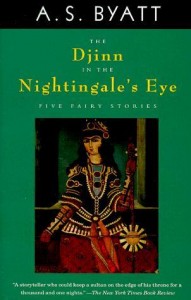
the djinn in the nightingales eye - as byattLately I’ve been drawn to fairytales and myths. Perhaps I am trying to recover an ebbing capacity for storytelling in my suddenly busy life, and perhaps I’m looking to get lost in the wonder of stories the way I did when I was a kid. Perhaps I’m missing afternoons at Louisa’s with Bob and Jack and their emphasis on the mythic journey. When I stumbled on AS Byatt’s The Djinn in the Nightingale’s Eye, I thought I wanted to read it because it spoke to the Arabian Nights, but what I fell in love with was the overall fairytale quality of the book and its five stories and what they told me about being a woman.

The Eldest Princess

In “The Story of the Eldest Princess,” the girl who goes on the quest to renew her kingdom is not the most beautiful of the sisters, she is the eldest. Sometimes it feels like our stories are only about the fairest of them all with the idea that everyone else is background. In this story, birth order is more important and princess status is not synonymous with beauty. The princess is not a victim of her fate and is rewarded for trusting her instincts. What I most liked is how the relationship between the crone and the princess spoke to a continuity of femininity and female knowledge that is too easy to ignore.

“There is always an old woman ahead of you on a journey, and there is always an old woman behind you too, and they are not always the same.” – AS Byatt, The Eldest Princess

The Djinn in the Nightingale’s Eye

There are many things to love about this story and how it portrays women. From the honest lustiness of Gillian (without the silly virgin tremble) to the unveiling of the desires of the Middle Eastern female. What I most loved was Gillian’s frank appreciation of her womanhood. When she is confronted with the opportunity to have anything she wants, she most wants to return to her body when she last liked it and that age is thirty-five. Perhaps this is vanity on my part as I am nearing that age and spend more time than I should worried about my “faults,” but I liked how the idea of a perfect female body is the body of a woman and not a girl. The djinn echoes this assessment. Though I do worry about the days after thirty-five and I hope I will continue to love my body as it follows the natural course.

“All love-making is shape-shifting—the male expands like a tree, like a pillar, the female has intimations of infinity in the spaces which narrow inside her” – AS Byatt, The Djinn in the Nightingale’s Eye

This book helped me appreciate myself as a woman. I loved that both the princess and Gillian are storytellers as I am. I hope my own stories will help future generations of women love themselves and to experience the infinite possibilities available inside the life the Fates assign.

If this review made you want to read the book, pick up a copy of The Djinn in the Nightingale’s Eye from Bookshop.org. Your purchase keeps indie booksellers in business and I receive a commission.
Filed Under: Books, Western Europe Tagged With: AS Byatt, book review, Fairytale, Fate, The Djinn in the Nightingale's Eye, Womanhood

Enduring Mundanity with William Trevor in After Rain

June 5, 2012 by Isla McKetta, MFA Leave a Comment

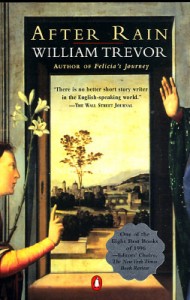
After Rain - William TrevorIn After Rain, William Trevor presents many stories that play with the reader’s plot expectations. Often he creates a compelling, even dangerous, scenario, but then the story unfolds to reveal that the reader was watching the magician’s assistant rather than his hands. Whether the crooks are the protagonists or the antagonists, the result is always the same: Trevor pulls the rabbit from the hat as we expected in the first place, presenting the triumph of conventionality.
In “Timothy’s Birthday,” Trevor writes of an old couple anxious for their son, Timothy, to come home and celebrate his birthday with them. The initial scene is warm and homey as Charlotte cooks and Odo prepares a fire. Timothy convinces a friend, Eddie, to go in his place and say he is ill. Charlotte is the picture of a concerned mother: “[Timothy’s] tummy played up a bit once.” Eddie makes himself at home, fixing the toilet and helping himself to gin and trinkets. The reader starts to worry for the old couple. Is Eddie going to hurt them?  How can he show such disrespect for people who have treated him so kindly?  But Eddie leaves and when Odo and Charlotte discover the missing decoration, “[t]heir own way of life was so much debris all around them, but since they were no longer in their prime that hardly mattered….Their love of each other had survived the vicissitudes.” They are beyond caring. They have endured and their life remains fundamentally unchanged.

“A Bit of Business” follows a similar pattern except this time we meet the crooks first as they rob the neighborhood while everyone is out waiting for the Pope. When we learn that Mr. Livingston is at home and elderly, the story seems to be set. Surely these youths will come upon Mr. Livingston and something dire will happen. The tension rises as Trevor cuts between the points of view of the thieves and of Mr. Livingston. “At once Mangan knew there was a bit of trouble.” They tie Mr. Livingston up and leave. So they haven’t hurt him, but still “[h]e’ll squawk his bloody guts out.” and they’ll get what’s coming to them. Surely they’ll go back to finish him off or at least they’ll get caught, but no, they pick up a couple of girls. In fact, it is the crooks who are changed by the encounter with Mr. Livingston: “[t]he lean features of Mr. Livingston were recalled by Mangan….they’d bollocksed the whole thing” and “there was nowhere left to hide from the error that had been made….Privately, each calculated how long it would be before the danger they’d left behind in the house caught up with them.” By having the thieves changed by their interaction with the normative Mr. Livingston, Trevor again creates an aura of the persistence of mundanity.

In “Widows,” Trevor set up a rivalry between sisters Catherine and Alicia with passages such as: “[i]n her girlhood she had been pretty – slender and dark….Alicia, taller, dark also, had been considered the beauty of the town.” But when Thomas Leary appeared and tried to bilk Catherine out of £226, my attention shifted to Thomas as Catherine’s antagonist. His deceit was compelling and I found myself wanting Catherine to stand up to him. Trevor kept Alicia present on the page through simple actions like “replacing forks and spoons in the cutlery container,” which built the expectation that the sisters have banded together in crisis. Alicia does back Catherine up against Thomas in conversation “‘[a]nything could have happened to the receipt….In the circumstances.’” However, when Catherine decided to pay Thomas, Alicia’s hopes were dashed and she turned on her sister: “[h]er expectation had been that in their shared state they would be as once they were….If Leary had not come that day there would have been something else.” The power struggle is once again between Catherine and Alicia. The story is not at all difficult to follow, but the shifting dynamics not only shows the complexity of the relationship between the sisters, it also conveys the sense that something would have come between Catherine and Alicia eventually. Thomas was merely a catalyst, interesting though he was, and the story remains as it ever was the rivalry between the sisters. In comparison to Thomas’s thievery, the sisterly feud seems quotidian and conventional, just where I have come to expect Trevor will leave me at the end of a story.

What was interesting to me about the structure of Trevor’s stories was how clearly they articulated a singular world view without seeming forced. He feeds the reader’s interest with some of the more seedy aspects of life, but his real interest seems to be conveying the fact that ordinary endures. I can learn from the complexity of the relationships he builds between characters such as Catherine and Alicia and Charlotte and Odo. Their encounters with the seamier side of life portray the characters’ normative lives much in the way that Gatsby was drawn through the negative space around him. There were other aspects of Trevor’s work that I can learn from as well, for example, the way he handles the letter in “A Day,” by never giving us the exact text of the letter but giving us enough information to infer it. I may in the long run look at his point of view shifts versus Mary Gaitskill’s.

If this review made you want to read the book, pick up a copy of After Rain from Bookshop.org. Your purchase keeps indie booksellers in business and I receive a commission.

Filed Under: Books, Western Europe Tagged With: After Rain, book review, British, Gatsby, Literature, Mary Gaitskill, William Trevor

Mercè Rodoreda’s Breathless Narrator in The Time of the Doves

May 28, 2012 by Isla McKetta, MFA Leave a Comment

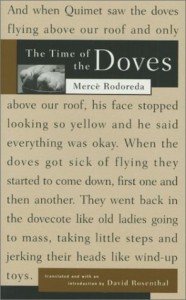
Merce Rodoreda The Time of the DovesThe narrative voice in Mercè Rodoreda’s novel, The Time of the Doves, wraps the reader in the dizzying world of a young woman. Through first person narration and the use of stream of consciousness, Rodoreda places the reader inside the head of Natalia as life happens to her.

Rodoreda starts sentence after sentence with “And,” even she using it as a conjunction between sentences: “[a]nd I stuck up for Quimet’s mother and said yes, she had put salt in the food. And the neighbor said if she ate food that was too salty it took her appetite away and Quimet said…”  This and the lack of commas gives Natalia’s narration a breathless feeling like she is so wrapped up in the story that she couldn’t stop talking if she tried. This hurriedness also gave me the impression that she wasn’t stopping to think about what she was saying, there was no after the fact analysis. It was an interesting effect for something narrated in the past tense. Most often writers add layers of reflection and reinterpretation to stories narrated in the past tense. The character has had years to mull over events and interject meaning. By combining the breathlessness with the past tense, Rodoreda gave me the impression that Natalia was reliving these events and there was a lot of unprocessed anxiety wrapped up in them.

Natalia is aware of the actions going on around her: “Quimet started complaining furiously about his leg;” and to a certain extent she feels how those actions impact her: “I felt like they’d emptied me out of myself and filled me with something very strange. Someone I couldn’t see kept blowing into my mouth and played at inflating me;” but she doesn’t even contemplate escaping it. Natalia needs a sympathetic audience and the reader is closer than a girlfriend to whom Natalia complains about her life, but she has no concept that she has any control over her own fate. This intimate quality means the reader is involved in Natalia’s confusion.

Natalia was so caught up in the whirlwind of her life that the war crept up on her. Her life existed outside of history or political context for most of the first half of the novel. Rodoreda drops in a reference to the king on page 71 and Natalia mentions “the rich were mad at the Republic.” It isn’t until “Cintet and Quimet never stopped talking about the street patrols and how they’d have to be soldiers again” that the war comes home for Natalia. This was a very interesting effect. Usually when I read books about wars, they are about wars, the war is heavily foreshadowed through the rest of the book and often there are battle scenes. What Rodoreda accomplished was showing how ignorant people can be about impending political strife when they are wrapped up in their lives. Natalia couldn’t meditate on ridding her house of doves, let alone how the political situation was shaping up around her.

Although I interjected my own thoughts and feelings into the novel, e.g. wondering why she didn’t know what a jerk Quimet was, so strong was the narrative voice that Rodoreda changed the way I read the book. Natalia is living without much premeditation, evidenced by sentences like: “[u]p to the moment he got undressed, you could say I’d never really taken a good look at him.” I am used to reading for clues to a character’s ultimate fate, to having some idea where the character is going. This sentence was like a smack in the face. It forced me to experience Natalia’s life as she was experiencing it because she was so unpredictable. I could worry for her, but I couldn’t anticipate her. We are so controlled by Natalia’s worldview that when “a militiaman knocked on the door and told me Quimet and Cintet had died” and she goes up to the roof “to breathe,” we don’t know if she is relieved or in shock or devastated.

I find myself slipping into the “and, and, and” mode sometimes when I am writing, but I usually go back and edit it out. This novel conveyed that sense of rawness, where the character is experiencing everything simultaneously, that I would like to experiment with, but I sometimes found it exhausting to read. I felt like I was being whipped around like Natalia was allowing herself to be and the only control I had was to put the book down. I think it is something I could use as an effect, but I wonder if I would be able to give up the control of having my characters act on their own behalves. Rodoreda’s treatment of Natalia and the war was spot on. To worry and anticipate political strife would have implied some sort of forethought and would have been completely out of character. I was truly placed inside Natalia’s world and at the mercy of her interpretation of it.

If this review made you want to read the book, pick up a copy of The Time of the Doves from Bookshop.org. Your purchase keeps indie booksellers in business and I receive a commission.

Filed Under: Books, Western Europe Tagged With: book review, breathless, catalan literature, Mercè Rodoreda, Murmurs of the River, narrator, The Time of the Doves

Henry Miller: Origins and Originality in Tropic of Cancer

May 26, 2012 by Isla McKetta, MFA Leave a Comment

Reading Henry Miller’s Tropic of Cancer, I felt like I was returning to the source. There were so many things I recognized in it from other books and other writers that I wondered if Miller was their originator or if he too got them from someone else.  From the “crazy little gesture” of the Polish-Irish-English con artist that smacks of Milan Kundera’s obsession with Agnes in Immortality to the phrase “apropos of nothing at all,” Miller left me wanting to consult some grand, comprehensive encyclopedia of intertextuality to see where these ideas were coming from and who else he had influenced and who had influenced him or how much of it had come out of the atmosphere of collective inspiration.

Miller’s stripped-down language and raw reportage made me feel like I was inside the story and experiencing it with him. After leaving Serge’s flophouse, the narrator describes being at a concert: “It’s as though I had no clothes on and every pore of my body was a window and all the windows open and the light flooding my gizzards.” The narrator goes on like that for almost a page with everyday words twisted into this extraordinary description.  As a reader I felt like I was an alien encountering my first concert and I loved it. It was strange but wholly evocative. Miller wasn’t writing about what happened at the concert but rather what it felt like to be at the concert. I wish I could do that.

Earlier in the novel Miller describes a dinner party at Tania’s and the effect is the same although his method is different. The paragraph contains no quotation marks but Miller is clearly capturing snippets of conversation: “Halitosis. Gaudy socks. And croutons in the pea soup, if you please.  We always have pea soup Friday nights. Won’t you try a little red wine?” The paragraph goes on and on and continues with, “My next play will involve a pluralistic conception of the universe. Revolving drums with calcium lights.” Miller ties together all these short crisp sentences that are at once related to the scene but unrelated to one another so as a reader I felt like I was trapped inside a cocktail party where all the conversation was distilled and thrown at simultaneously. It is manic and dizzying and I loved it.

Miller also has a way of sketching a character with only a few short images. In reference to Olga he writes, “She weighs almost as much as a camel-backed locomotive; she drips with perspiration, has halitosis, and still wears her Circassian wig that looks like excelsior.” It’s incredible. He could have just said she was fat and had bad breath and an afro, but the way he wrote it engages the reader. The oddness of the Circassian reference threw me off balance a little and made me want to draw more of a mental image of this woman. I felt like I would recognize her anywhere.

Miller’s wild descriptions also mirror the wild bohemian lifestyle he was writing about. Even if he hadn’t written about drinking, I felt intoxicated reading these passages. There is a freedom and wildness in these descriptions that I envy. Miller manages to convey both the sense of what is going on and also the feeling of it all happening.

If this review made you want to read the book, pick up a copy of Tropic of Cancer from Bookshop.org. Your purchase keeps indie booksellers in business and I receive a commission.

Filed Under: USA & Canada, Western Europe Tagged With: American Lit, Anais Nin, book review, Henry Miller, Immortality, Intertextuality, Interwar, Language, Milan Kundera, Tropic of Cancer

Three Things at Once: Charles Baxter’s Character Descriptions

May 17, 2012 by Isla McKetta, MFA Leave a Comment

a relative stranger charles baxter

In the stories in A Relative Stranger, Charles Baxter allows his characters to be seen through the eyes of other characters and what the observing character notices often tells as much about them as about the observed. All of this is brought together with brightly active language with connotations far beyond the few words spelled out on the page.

Prowlers

In “Prowlers,” Robinson, observes of his daughter: “[b]ehind her brown-rimmed glasses, her eyes are fierce. She looks like a twelve-year-old district attorney with a good case and witnesses.” He feels as though his daughter has put him on the defensive. She is young, “twelve,” but she is also insistent and he knows she has a point. She goes on to push him with questions about his wife who is downstairs flirting with his best friend. She is “fierce” in confronting the truth that he would rather avoid as he sits in his room writing about faith rather than insisting on faithfulness.

Westland

In “Westland,” Warren observes Earl’s new woman, Jody. He says: “she was pretty in the details, and when she looked at Earl, the lenses enlarged those eyes, so that their love was large and naked and obvious.” He doesn’t describe her eyes as doe-like, but the image is there all the same. Warren sees Jody as innocent, more innocent than Jaynee. Jody is not a classic beauty, but Warren finds her “obvious” devotion to Earl attractive but also simple. Warren with his background in therapy is observing a messy family dynamic between Earl, Jody, and Jaynee and he is simultaneously pulled in by the bareness of their relationships to one another and also repelled by the obvious dysfunction.

The Old Fascist in Retirement

When the old fascist in “The Old Fascist in Retirement” observes “that rare green scent of oak leaves that American women sometimes carried with them: the odor of innocence, the odor of what-if-everybody,” he is reacting as much to the woman’s culture as to her. The word “green” connotes freshness and his repetition of the word “odor” implies stench more than other words he could have used like “aroma” or “smell.”  And his reference to “what if everybody” is a direct rebuke of the openness of American culture in contrast to his own. He later goes on to talk about the sense of history of the long-living oak tree.

The implication of meaning is also something I enjoyed in Grace Paley’s writing. I like the unexpectedness of some of Baxter’s phraseology. The viewing of one character through the eyes of another is something I enjoyed in F. Scott Fitzgerald’s writing. This colorful observation of one character by another gives the reader a rich view of both characters. I can learn from the economy of describing two characters at one time. One is described explicitly and the other implicitly through the author’s careful portrayal of what is important to that character. It allows a deeper understanding of the character. The grace with which Baxter introduces an abstract idea and then elucidates it just enough to get the reader’s mind moving around the possibilities implied by the words he has chosen is enviable.

If this review made you want to read the book, pick up a copy of A Relative Stranger from Bookshop.org. Your purchase keeps indie booksellers in business and I receive a commission.

Filed Under: Books, Western Europe Tagged With: book review, Brit, characterization, Charles Baxter, Fitzgerald, Lit, Relative Strangers

  • « Previous Page
  • 1
  • …
  • 6
  • 7
  • 8
  • 9
  • 10
  • Next Page »
  • Goodreads
  • RSS
  • Substack
  • Tumblr

Get New Reviews Via Email

My Books

Polska, 1994

Polska 1994

Clear Out the Static in Your Attic

Clear Out the Static in Your Attic_cover

Recent Posts

  • Watching Train Dreams and Longing for A River Runs Through It
  • Another Kind of Symmetry by Angela Jane Fountas and the Road Less Traveled
  • The Tension of Truths in Raised by Ferns by Maya Jewell Zeller
  • Wisława Szymborska’s The Acrobat and the Strength of Simplicity
  • Franny Choi’s We Radiant Things and What Robots Can Teach Us About Being Human

What I’m Reading

Isla's bookshelf: currently-reading

Birds of America
Birds of America
by Lorrie Moore
The Ecstasy of Influence: Nonfictions, Etc.
by Jonathan Lethem
The Souls of Black Folk
by W.E.B. Du Bois
Bomb: The Author Interviews
by BOMB Magazine
On Writing
On Writing
by Jorge Luis Borges

goodreads.com
Privacy & Cookies: This site uses cookies. By continuing to use this website, you agree to their use.

To find out more, including how to control cookies, see here: Cookie Policy
Content copyright Isla McKetta © 2026.