• HOME
  • REVIEWS
    • Books
      • Africa
      • Arabia
      • Asia
      • Eastern Europe
      • Latin America
      • South Pacific
      • USA & Canada
      • Western Europe
    • Other Media
      • Art
      • Film
  • EDITING SERVICES
  • ABOUT
    • Bio
    • Creative Writing
      • Clear Out the Static in Your Attic: A Writer’s Guide for Transforming Artifacts into Art
      • Polska, 1994
    • Artist Statement
    • Artist Resume
    • Contact
    • Events
    • Professional Portfolio
  • BLOGROLL

A Geography of Reading

"It is by reading novels, stories, and myths that we come to understand the world in which we live." -Orhan Pamuk

Tadeusz Borowski and the Gift a Writer Can Give

October 26, 2012 by Karen Hugg, MFA Leave a Comment

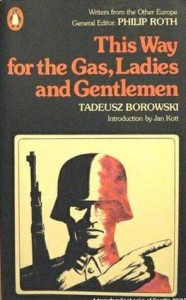
this way for the gas ladies and gentlemen tadeusz borowskiIn terms of historical importance, little more can be said of This Way for the Gas, Ladies and Gentlemen. It, like Night, is a testament to the Nazis’ atrocities at Auschwitz. While contemporary novels wink at us with wit and an ironic tone, Tadeusz Borowski’s work floats above like a wise parent whose wrenching past overwhelms the smallness of our daily distractions and grievances. To say it’s one of the most valuable books of the twentieth century is a meager compliment.

How Borowski Came to Write This Way for the Gas, Ladies and Gentlemen

In 1943, Borowski was arrested for participating in the underground education in Poland, a network of students and professors who privately continued university studies despite the Nazis ban on secondary schooling. Education had been outlawed in an effort to dumb down and enslave the Poles. Borowski was taken to Auschwitz where he worked as a laborer, unloading the cattle cars and other tasks assigned to him. He, already a journalism student, documented his experience, but this book isn’t just a memoir of events by a well-meaning but clumsy writer. It’s brilliant for its craft as well.

Discovering the Meaning in the Details

Borowski renders the inhumane events he witnessed with a removed, sometimes cynical, tone. This seems to be an act of self-preservation, compartmentalizing the horror in order to preserve his sanity and therefore his life. And so, his commentary is in how he chooses to portray what he sees. For instance, Tadek, Borowski’s literary self, describes a young German guard as having “corn coloured hair and dreamy blue eyes.” This creates a chilling portrait of the guard when the guard sells Tadek’s co-laborer a drink of water. Borowski notes the railway station is “surrounded by trees” and “a cheerful little station, very much like any other provincial railway stop,” and therefore, contrasts the regular outside world with the unspeakably violent one inside Auschwitz’s gates. By stringing together events like, “They throw her on the truck on top of the corpses. She will burn alive along with them,” and then opening the next paragraph: “The evening has come, cool and clear. The stars are out. We lie against the rails. It is incredibly quiet,” we understand in achingly vivid terms how the only solace these survivors have in the hellish world of Auschwitz are the moments of rest and cool air in between the exterminations.

Similarly in the story, “The People Who Walked On,” we see Tadek playing goalkeeper in a soccer game and how in between two throw-ins, three thousand people are put to death. When he runs to retrieve a ball, he catches sight of the newly arrived train: “People were emerging from the cattle cars … bright splashes of colour. The women were … already wearing summer dresses. The men had taken off their coats, and their white shirts stood out sharply against the green of the trees…” Later, when he runs back to retrieve the ball again, the ramp is empty: “Out of the whole colourful procession, not one person remained.” Borowski’s choice to describe how beautiful the crowd looked in the warm evening starkly lays out for us the price of life that was lost and how, when the train ramp is empty, the sublimity of their humanity has been annihilated by the Nazi’s efficient, organized terror that leaves no one behind.

At the war’s end, the Allies arrive and liberation is clear. But Borowski frames the story as one about revenge, rather than rescue. There are no melodramatic descriptions of the Allies arriving or the Nazis fleeing, only a brief tale about how the prisoners hid “our man,” presumably an S.S. officer or guard, while the American soldiers spoke to him in a larger group about upholding the law, then pulled him out and beat him to death. It’s an exemplary case of how straight depiction is far more powerful than editorializing.

How to Write After Reading Such Strength

Reading Borowski made me question what I write about. Next to This Way for The Gas, my work feels insignificant and erasable. But though my life has been blessed with peace and been free of ongoing oppression, I have faced serious challenges and wrenching, painful moments. Borowski taught me that those experiences may be the most important for me as a writer. They will enlarge and deepen my work. The trick is to keep them in my mind and heart each day that I write.

If this review made you want to read the book, pick up a copy of This Way for the Gas, Ladies and Gentlemen from Bookshop.org. Your purchase keeps indie booksellers in business.

Filed Under: Books, Eastern Europe Tagged With: contrast, Holocaust, Polish Literature, World War II

The Methods in Jakov Lind’s Madness

October 5, 2012 by Karen Hugg, MFA 1 Comment

lind-soul-of-woodMost stories don’t smash me to bits. As I read them, I’m moved, enchanted, worried, dismayed, relieved, sometimes annoyed. But Jakov Lind’s Soul of Wood and Other Stories just left me flattened, feeling empty, and as if I were stranded in a strange shapeless place. The question “Wow, what was that all about?” kept looping in my head like a song, and I was unable to find an answer.

But I think the answer lies in not only the mad brilliance of the story itself, but more so, for me as a writer, in the craft of how Lind created the story. By story I mean the novella, Soul of Wood, which opens the collection. The later short stories are also impressive in their own way, but Soul of Wood is the masterpiece. It’s set in Austria in the 1940s and follows Wohlbrecht, a crippled Austrian soldier, who works to hide Anton Barth, a mostly paralyzed Jewish boy, in a mountain cabin. He enlists the help of Alois, his brother-in-law, and the first half of the book centers on the two’s endeavors of dragging Barth up through the woods while trying to avoid the Nazis and their random air attacks.

Shot from all Sides by Point of View

Lind’s voice is somehow casual, witty, romantic and brusquely masculine all at once. It doesn’t just blast its way through the narrative, but rather tumbles with a clear urgency. This was probably the first technique that I’d love to emulate (oh, if I could.) But what’s crazier and even more unattainable is how the point of view wanders. It, at times, becomes dreamy and surreal before landing flatly in stark reality. Take, for instance, the following passage occurring early in the story, which by the way could be a spoiler, depending on how you view the narrative. Read at your own risk.

As Wohlbrecht and Alois return from the cabin, they stop at the side of the road. Wohlbrecht lays and dozes in the hay as Alois talks of his post-war plans. Alois plans to visit Rumania in an effort to cure his epilepsy. In one paragraph, Alois talks about a renowned doctor and his treatment that Alois believes will mend all aspects of his life. In another, the grand wealth that he and all of Vienna will enjoy after the war. As readers we are relaxed at this point in the passage, imagining hopeful situations and feeling a tender intimacy with Alois.

Then: “The loud engine sounds woke up Wohlbrecht.” This kicks off a random rotation of omniscient narration, stream of consciousness and Wohlbrecht’s spoken words. There’s little punctuation to help us distinguish between what’s happening, what’s being said and what’s being thought.

“Jumping Jesus, he cried, they’ll fly right up my ass. A burst of machine-gun fire beat down like rain on the tin roof and by the time Wohlbrecht cried ‘Cover!’ Alois was dead. Hit right in the back of the head. The blood gushed like a geyser. Alois, Alois, Wohlbrecht yelled thinking he was still asleep. Alois, where’d it get you? Alois didn’t move. Alois, don’t pretend, say something. Alois said nothing. It was so still he could hear a beetle scratching in the hay.”

Here, this mishmash of point of view hits us in the gut. We’re dealing with the sudden chaos of the moment, which poetically reflects the sudden chaos of the entire war experience. It also shows the contrast between life and death, the potential of the future and the negation of it in how Alois is dreaming of better years to come when he is suddenly killed. By the end of these few paragraphs, we’re jarred, upset, and left processing what just happened – as Wohlbrecht is. Lind doesn’t just describe trauma, he hurls us into it so we experience it first hand. That he does this by manipulating point of view is amazing.

There are other amazing aspects to Soul of Wood as well. The plot of the book later bends back on itself and we discover that much of the seemingly random events, forgotten images and off-hand mentions of names and people actually come together in a larger symbolic coherence. That coherence makes this novella one of the most under-appreciated of our time.

The Shorter Works

The Other Stories in the title are mostly outlandish, grotesque short stories rooted in the trauma of World War II. In one, a piano teacher is haunted by his past as an S.S. officer. A traveler stumbles upon a family of cannibals. A man follows his neighbor to a kind of speakeasy only to find a featureless woman who somehow sets him free. A killer about to be executed dreams of killing his father in revenge. Two men, a Jew and a Catholic-converted-Jew, share a snug hole as they hide from the Nazis. Somehow these shorter pieces unfold with a tongue-in-cheek wit. They’re also somewhat allegorical though what they represent is too complex and hidden to explore here. Suffice to say they embody Lind’s seemingly unstable spirit, macabre wit and clever narrative arcs, which leave writers like me both horrified and smiling.

If this review made you want to read the book, pick up a copy of Soul of Wood from Bookshop.org. Your purchase keeps indie booksellers in business.

Filed Under: Books, Eastern Europe Tagged With: Austrian Literature, book review, Point of View, World War II

Drakulić Decrypts the Language of Mothers and Daughters in Marble Skin

September 11, 2012 by Isla McKetta, MFA Leave a Comment

Is there a relationship more complex than that between a mother and a daughter? Love and admiration mix ineffably with jealousy and resentment. Through the seemingly simple (but deeply layered) language of Marble Skin, Slavenka Drakulić unweaves the conflicts and emotions that estrange and entangle women.

A girl admires her mother’s body and yearns for the day when her own will blossom. If she becomes impatient with the slowness of her growth, jealousy of her mother’s womanliness can take root. The mother in turn becomes jealous of her daughter’s youth.

Drakulić’s narrator deftly slips through time as she expresses this love, admiration, and resentment for her mother. She outlines with equal complexity the feelings of a burgeoning adolescent for her stepfather and how his presence catalyzes the relationship between mother and daughter.

”We don’t have a body, we are a body” – Slavenka Drakulić

At the beginning of the book, the narrator is reflecting on an art show and a comment by a friend that her “sculptures of the female body seemed eaten away from the inside.” She begins sculpting her mother’s body. As she shapes breasts and thighs, she begins thinking of her mother’s body and of a scene she witnessed as a child.

The Primal Scene

Psychoanalysts talk about the primal scene when a child witnesses a sex act and it affects her view of sexuality for life. The narrator views a watches her stepfather in a sexual act with her mother in their marriage bed. It is an act this man will later reenact with the girl.

The way Drakulić crafts the scene, with a gentle allusion to Alice in Wonderland, the reader simultaneously experiences the dread of entering the room as an adult and the memory of the mother’s body splayed on the bed. Without revealing the later molestation, the reader is still left with the sense of a lurking secret. The sense of the small child within all of us.

What was most haunting about the book for me was that these are normal human emotions that I have experienced but never knew how to express. Drakulić split open her characters and subjected them to horrible things and their responses always returned to the common human reactions. Witnessing the girl’s devastation of sexuality helped me understand my own relationship with sexuality.

The Craft of Writing

It may be evident by the somewhat articulate nature of this post so far, but this book invaded my psyche in a way I can’t yet understand. The simple sentences expressed emotions I had been trying to unlock and explain for decades. The metaphors were gentle and expansive. The literary allusions were subtle and perfect.

”With this one sentence I emptied her out, like squeezing a tube of oil paint.” – Slavenka Drakulić

Drakulić emptied me out too. Her writing ate away at me from the inside. I’m putting the book aside until I can read it again. I think I can read and reread this book for decades and it will still have things to teach me about writing and about being a woman. That is the most beautiful feeling in the world.

If this review made you want to read the book, pick up a copy of Marble Skin from Bookshop.org. Your purchase keeps indie booksellers in business and I receive a commission.

Filed Under: Books, Eastern Europe Tagged With: book review, Croatian literature, Feminism

Bringing Light to Characters in In Darkness

July 19, 2012 by Isla McKetta, MFA Leave a Comment

Writing rich characters can be difficult. I’ve been told I should take a stereotype then add something unexpected—as though two dimensions plus one quirk equals a round character. But humanity is more than two layers deep and your audience can tell the difference. Agnieszka Holland’s film In Darkness, written by David Shamoon, displays some of the richest characters I’ve seen in a while.

I will admit to Holocaust fatigue and I was leery of this film for that reason. I’ve been reading various memoirs and histories of the horrors for over two decades. While there is no end to the human suffering that the Nazis inflicted, there is a limit to the nuance I can absorb from these stories. It was daring to try and tell a new story. But the movie succeeded.

I don’t normally review movies (though I might start doing more) but this one is related to TWO books: In the Sewers of Lvov by Robert Marshall and The Girl in the Green Sweater: A Life in Holocaust’s Shadow Krystyna Chiger.

Our Hero

The protagonist, Pan Socha, is a Polish sewer worker during WWII who makes extra money on the side by looting the homes of recently relocated Jews in Lvov. When he hears some Jews trying to escape the ghetto by breaking into the sewer, he could make the obvious choice—the one that is “in character,” but his character is richer than that. Throughout the movie he continues to wrestle between his selfish motivations (greed, not getting shot by Nazis) and his need to do the human thing and help save those lives.

Socha continues to wrestle with his base greed throughout the film, but he also displays growth. There is a moment where he defends Jews as a people (a very dangerous thing to do) while lecturing his friend in a public place. At another time, he steps from the shadows to save the life of a Jew who had given him nothing but trouble.

Socha made Spielberg’s Oskar Schindler look two dimensional. Yes, there is the moment at the end when Schindler cries because he could have saved more Jews, but it felt like a tacked on emotion rather than a breakdown. Socha evolves and grows throughout the film, and though he is imperfect, I loved him for it.

Other characters

Socha’s wife has a central conflict that is very simple, but the way it manifests is beautiful and rich. She initially teaches her husband that Jews are just like everyone else and gives him a lesson on religion to prove it. But when she finds out he is helping Jews, she is livid. You can see her wrestling between her humanity and her need to preserve her family. She does this over and over throughout the film.

Klara Keller also has conflicting desires—she is trying to keep alive the sister she never really liked. Yanek is forced to choose between his wife and his lover and even then can’t find peace. In fact, every character in this film seems torn which befits a movie about such a turbulent time.

Perhaps that’s where some Holocaust portrayals fail—they turn into tales of good and evil. Holland and Shamoon forced me to examine the good and evil within myself. Perhaps the best reason to create robust, lifelike characters is to encourage your readers to examine that complexity within themselves.

Note: I completely failed to credit the writer in the original post. This has been revised to reflect the exemplary work of David Shamoon.

Filed Under: Eastern Europe, Film, Other Media Tagged With: characterization, Holocaust, Poland, round characters, World War II

The Book of Laughter and Forgetting: Variations on a Form

July 11, 2012 by Isla McKetta, MFA Leave a Comment

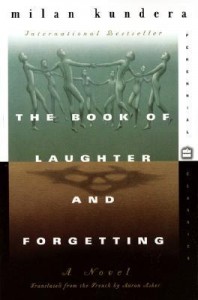
book of laughter and forgetting - milan kunderaMilan Kundera discusses variations in The Book of Laughter and Forgetting: “Variation form is the form in which concentration is brought to its maximum; it enables the composer to speak only of essentials, to go straight to the core of the matter.” He goes on to write, “This book is a novel in the form of variations. The various parts follow each other like the various stages of a voyage leading into the interior of a theme, the interior of a thought.” The form he chooses to use for this book, the form of variations, provides the majority of the structure for the novel.

Without acknowledging this structure, the sections of the book are only loosely related through theme or geography. Mirek is a Czech writer who in visiting a former lover leaves his political writings and letters at home exposed and vulnerable to seizure by the secret police. Marketa and Karel are being visited by their lover, Eva, and Karel’s forgetful mother, Mama. Mama helps Karel remember a childhood attraction to his mother’s friend, a woman who reminds him of Eva, and this one clear memory reconciles him with his mother. Two American girls discover the power of laughter in a small French town. The narrator recounts a story of clandestinely writing a column and his musings on circles (having stepped outside and being unable to rejoin). Then there is Tamina, who is by Kundera’s admission, the focus of the novel. She fled Prague with her husband who died tragically soon after. She longs to have the letters and journals she left behind to relive their life together. She allows Hugo to have sex with her, but he never retrieves the letters. Kristyna is an older woman from a small town who has an unconsummated affair with a student poet. Tamina is spirited away by a man who asks her to “forget your forgetting” and then she travels over water to a place where children molest her and she cannot swim home. Jan goes to a beach house where everyone has sex with everyone.

Themes emerge, laughter and forgetting of course, but also litost, dangerous papers, meaningless sex. The characters sometimes show up again, but never outside of their original context. Their lives never physically overlap with anyone from other sections. What do recur are variations on themes. Papers are lost and it turns out the value wasn’t contained in the papers themselves, but in the writer’s memory. Characters grow close through their connections and shared experiences, not through sex. Sex is itself meaningless or sometimes a violation. Some steps, whether leaving your country or giving up on life, cannot be retraced (the circle cannot be re-entered).

To be honest, the book was a bit over my head, and I struggled to see the connections between the sections. I did enjoy, though, the way it made me look at the themes more closely. Because the characters were not related to each other and did not recur outside of their own contexts, my attention was directed to the elements that recurred and I started to make meaning from those connections. I don’t think I would go this far in my own work, I am still married to a more traditional narrative, but I can see how Kundera allowed me as a reader to use the natural human tendency to seek meaning to engage me in this work. I am interested in seeing whether themes can take on the same importance without removing as much of the connection between the characters and the reader as Kundera has.

If this review made you want to read the book, pick up a copy of The Book of Laughter and Forgetting from Bookshop.org. Your purchase keeps indie booksellers in business and I receive a commission.

Filed Under: Books, Eastern Europe Tagged With: Czech Literature, fractured narrative, Repetition, Variations

  • « Previous Page
  • 1
  • 2
  • 3
  • 4
  • 5
  • 6
  • 7
  • Next Page »
  • Goodreads
  • RSS
  • Substack
  • Tumblr

Get New Reviews Via Email

My Books

Polska, 1994

Polska 1994

Clear Out the Static in Your Attic

Clear Out the Static in Your Attic_cover

Recent Posts

  • Wisława Szymborska’s The Acrobat and the Strength of Simplicity
  • Franny Choi’s We Radiant Things and What Robots Can Teach Us About Being Human
  • Close Observations of Humanity in A Moment’s Surrender
  • Seduced by It’s a Business Doing Pleasure With You
  • Close Encounters with Disclosure Day

What I’m Reading

Isla's bookshelf: currently-reading

Birds of America
Birds of America
by Lorrie Moore
The Ecstasy of Influence: Nonfictions, Etc.
by Jonathan Lethem
The Souls of Black Folk
by W.E.B. Du Bois
Bomb: The Author Interviews
by BOMB Magazine
On Writing
On Writing
by Jorge Luis Borges

goodreads.com
Privacy & Cookies: This site uses cookies. By continuing to use this website, you agree to their use.

To find out more, including how to control cookies, see here: Cookie Policy
Content copyright Isla McKetta © 2026.