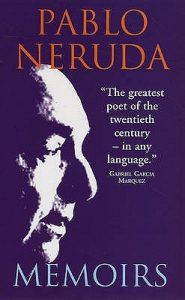
 Pablo Neruda had a fascinating life and met all sorts of interesting people from Che Guevara to Federico García Lorca. But in reading his Memoirs, I felt like he was recounting all of these stories to me as opposed to letting me relive them with him. Although Neruda uses some dialogue, he rarely ventures into full-blown scene. The closest he gets are little vignettes like:
“A few hours later I was buying some apples in a fruit store when a horse-drawn carriage halted at the door. A tall, ungainly character dressed in black got out of it. He, too, was going to buy apples. On his shoulder he carried an all-green parrot, which immediately flew over to me and perched on my head without even looking where it was going.”
This section proceeds for three more paragraphs in ten lines as Neruda inquires about the man’s identity. The last paragraph is, “I didn’t know him and I never saw him again. But I accompanied him into the street with due respect, silently opened the carriage door for him and his basket of fruit to get in, and solemnly placed the bird and the sword in his hands.” It is interesting for certain, but it seems as though Neruda is ascribing meaning to the interaction that the reader does not necessarily have access to.
Neruda utilizes a lot of description in his summary and his language is quite poetic, but it is always presented to the reader rather than experienced. There are passages of pure narration that are quite pleasant, “I am writing in Isla Negra, on the coast, near Valparaíso. The powerful winds that whipped the shore have just blown themselves out. The ocean—rather than my watching it from my window, it watches me with a thousand eyes of foam…” At the end of many chapters he includes passages of commentary so descriptive and without chronology or incident that it may be a poem and seem better understood by the soul than the mind: “…How many works of art…There’s not enough room in the world for them anymore…They have to hang outside the rooms…How many books…”
The effect is that the reader is completely at Neruda’s mercy. When something historical or salient emerges, I expect scene and get summary. When he is musing on mundane details, Neruda comes closer to scene than anywhere else in the narrative. It is difficult to engage in a normal fashion with the book for this reason. But he did lead a fascinating life.
I find I am increasingly drawn to books with strong narrators, like Pynchon, Kundera, and Duras, who can weave a spell for me and let me surrender to the narrative. What this book shows me is that a strong narrator is not enough. The narrator has to let me into the world, to give me the keys as it were, otherwise I feel like I am watching Last Year at Marienbad—interesting, but I don’t necessarily understand it enough to engage with it. Most of Neruda’s writing is intelligible, but the lack of sensory detail in the vignettes kept me separate from the narrative. I want to be careful of this in my own work. I am learning it is alright to tend towards summary rather than scene, but if I do, then I have to be very careful about engaging the reader. Otherwise it becomes an oration, not a narration. Readers often pick up a memoir because of who wrote it. Fiction writers need to first build trust with a reader before the reader will follow them.
If this review made you want to read the book, pick up a copy of Memoirs from Bookshop.org. Your purchase keeps indie booksellers in business and I receive a commission.
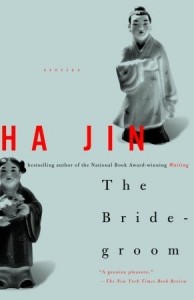 In Ha Jin’s collection of stories, The Bridegroom, the protagonists are powerless to effect any real change in their circumstance. At best they can hope for vengeance by spreading disease or peeing on purslanes. Ha creates this feeling of constraint and hopelessness in “Saboteur” by tightly controlling his delivery of words.
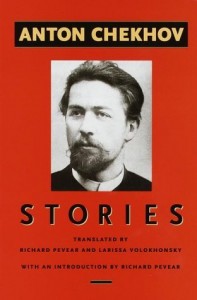 Chekhov names the nature of Olenka’s character early in the story in the following passage: “She was always fond of some one [sic], and could not exist without loving.” He then mentions some of the family members she has loved. But prior to this, her husband, Ivan Petrovitch Kukin, (aka Vanitchka) has had a large blowup about the vulgarity of the patrons of the story. I was drawn into the drama of Kukin and didn’t see this first clue, the subtle unfurling of Olenka’s personality. When she first parrots his opinion, “‘But do you suppose the public understands that?’” I thought we were seeing an action she would habitually take, but I didn’t yet realize this was the key to her nature. It isn’t until Chekhov revealed that the actors referred to her as “Vanitchka and I” that I got the point.