• HOME
  • REVIEWS
    • Books
      • Africa
      • Arabia
      • Asia
      • Eastern Europe
      • Latin America
      • South Pacific
      • USA & Canada
      • Western Europe
    • Other Media
      • Art
      • Film
  • EDITING SERVICES
  • ABOUT
    • Bio
    • Creative Writing
      • Clear Out the Static in Your Attic: A Writer’s Guide for Transforming Artifacts into Art
      • Polska, 1994
    • Artist Statement
    • Artist Resume
    • Contact
    • Events
    • Professional Portfolio
  • BLOGROLL

A Geography of Reading

"It is by reading novels, stories, and myths that we come to understand the world in which we live." -Orhan Pamuk

Embodiment and Disembodiment in The Lover

May 6, 2012 by Isla McKetta, MFA Leave a Comment

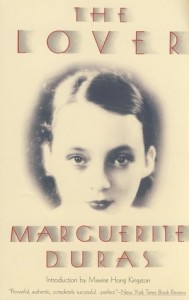
the lover marguerite duras

Marguerite Duras throws the reader into the memory of her narrator in The Lover. By switching narration between the first person and third person limited, Duras embodies the experiences of a fifteen and a half year-old girl who takes on a Chinese lover in Saigon. She also conveys the sense of the girl as object which allows the reader to both sympathize with the character and subject her to judgment. This mimics the way the narrator is simultaneously reminiscing about a specific period in her adolescence and also judging herself.

Because the narrative voice doesn’t change when the narrative point of view does, the reader has the sense that the same first person narrator is relating the story from two angles. In one section the narrator describes her shoes: “These high heels are the first in my life, they’re beautiful, they’ve eclipsed all the shoes that went before.” This is followed by a section break and then the very next sentence is: “It’s not the shoes, though, that make the girl look so strangely, so weirdly dressed.” Three sentences later in the same section the narrator is back to first person in describing the provenance of the hat she was wearing: “How I came by it I’ve forgotten.” In each of these sections, the narrator is talking about the same girl and her possessions but the reader is encountering her as both separate and part of the narrator.

Switching back and forth between narrative points of view could be maddening for a reader, but the switch is seamless and gives the reader a much fuller picture of the narrator’s recollections than one viewpoint or the other could have done. The ease of transition is accomplished by zooming in to look at one object (here the shoes and the hat) and then zooming back out to show the same object from a different vantage point.

The key to the reasons behind the shift in perspective is in the following passage: “He answers my mother, tells her she’s right to beat the girl…The mother hits her as hard as she can.” I was struck by the poignant disassociation in the shift here as the narrator transitions from “my mother” to “the girl.”  Moments before, the narrator used the first person to describe the beginning of the incident: “My mother has attacks during which she falls on me…punches me.” “Has attacks” is habitual, not of the moment, and not in scene. But as the description progresses, the specificity of the action as the other brother flees and the mother calms down and the girl lies about her relationship with the Chinese man, makes the description seem like one particular instance. The narrator is separating herself from the girl who is the center of this action. She sets herself apart from the chaos and pain of these relationships as though it happened to someone else. This disembodiment is characteristic of someone who has undergone trauma and is particularly poignant because the character is at an age where one internalizes this type of experience and blames oneself for it.

Shifting back and forth between these narrative points of view is tricky, but Duras managed it well. As a reader, I was able to engage with the character on a deeper level and could feel the shift into third person almost as the narrator’s wince. I don’t think this could be prudently imitated except in the rarest of circumstances because it creates a very specific effect. However, it is important to keep in mind that our characters, being the astute little observers that they tend to be, are likely aware of how they are perceived. There are other ways to view even a first person narrator from the outside, e.g. conveying anxiety at how they are being perceived. In my novel, Polska, 1994, being seen and the perceptions of others is an important part of Magda’s world and I work to show this through how she thinks others are seeing her. Duras reminded me that it is important to consider how my character views herself.

If this review made you want to read the book, pick up a copy of The Lover from Bookshop.org. Your purchase keeps indie booksellers in business and I receive a commission.
Filed Under: Asia, Books, Western Europe Tagged With: book review, Duras, French Literature, Murmurs of the River, Point of View, The Lover

Tagalog Words, Filipino Flavor in Dogeaters

April 28, 2012 by Isla McKetta, MFA Leave a Comment

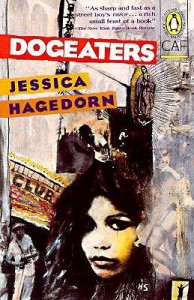
Jessica Hagedorn - DogeatersI’m thinking a lot about the feel of foreign words on the tongue and in print lately, so I want to talk about Jessica Hagedorn’s Dogeaters. She uses Tagalog and Spanish words throughout this novel set in the Phillipines. Most often these phrases are used in dialogue and consist of exclamations, family designations, or food. Hagedorn sets aside the words for the reader by using italics, but it is clear that the intermingling of these words would occur naturally in the characters’ speech. These words lend the story authenticity, but they can also interfere with the reader’s understanding of the story.

Spanish

The Spanish words Hagedorn uses are easily intelligible and familiar, I imagine, even to many readers who don’t speak Spanish. Words like “abuelita,” “hija,” and “prima” are all family designations and are used with varying regularity in novels set in America. Hagedorn uses the Spanish “abuelita” to differentiate between Rio’s two grandmothers. Both women are Filipina, but one has moved to Spain and considers herself more Spanish. Rio’s Filipina grandmother, Narcisa, is addressed as “Lola” while her grandmother with Spanish pretensions, Socorro, is addressed as “abuelita.”

Tagalog

Some of the Tagalog words Hagedorn uses are easily understandable based on the context clues around them: “[i]t is merienda time at the popular Cafe España.” It is clear that “merienda” has something to do with eating. As the novel progresses, Hagedorn uses the word over and over and the reader’s understanding of the word is enriched. Although I never fully understood the word, I came to understand “merienda” happens in the morning and may be akin to brunch. I was able to substitute “brunch” for “merienda” and at least understand what was going on in the scenes. A similar thing happened with “tsismis.”  At first I had no idea what the characters were talking about, but by the time I read Rio’s father saying to her mother: “what do you do all day for exercise, except move your mouth up, down, and sideways, making tsismis with your queers,” I understood it meant gossip.

Defining Words in the Text

There were two instances where the non-English words were described by the characters themselves. In the first, Rio is describing her family and says: “Uncle Cristobal flies a Falangista flag above his front door to show his allegiance to Franco.” While I have no idea what the flag looks like, I completely understand its meaning and how it might pigeonhole Cristobal politically. The second instance is while Rio’s mother and father are discussing the difference between “putok” and “spiritik,” both of which mean fake. Rio’s father says: “Congressman Abad spiritiks when he plays golf, but General Ledesma rewards his army with cases of putok liquor.” I learn the nuance of the connotations of the two words, but Hagedorn also weaves in some of the flavor of local politics at the same time.

There are phrases that I never even quite got the gist of throughout the novel. Many of these seemed like interjections. One of these was “di ba” and another was “puwede ba.” They occurred frequently in conversation, often followed by an exclamation point, but with context clues. I interpreted them as exclamations, and I didn’t feel like I lost a major point of the sentence by not understanding them, but I never did get the full flavor of the sentence.

I am used to understanding even foreign words in novels, and it was a switch for me to not be able to understand exactly what was going on at all times. Hagedorn’s use of Tagalog made me more conscious of my use of Polish in my novel, Polska, 1994. Because Polish is, like Tagalog, not widely spoken outside of its native country (and expat communities), Hagedorn is teaching me to use context clues to help the non-Polish speaker understand the words. These foreign words and phrases need to be at least intelligible to an English-speaking reader, even if they convey a deeper meaning to a Polish-speaking reader.

If this review made you want to read the book, pick up a copy of Dogeaters from Bookshop.org. Your purchase keeps indie booksellers in business and I receive a commission.
Filed Under: Asia, Books Tagged With: book review, Dogeaters, Jessica Hagedorn, Literature, Murmurs of the River, Spanish, Tagalog

Yasunari Kawabata’s Quiet Contradiction in Snow Country

April 20, 2012 by Isla McKetta, MFA Leave a Comment

Yasunari Kawabata Snow Country

Snow Country by Yasunari Kawabata is a compact little book and though quiet, it has a lot to say. Because there are no large actions until the end of the novel, it is easy as a reader to devote great attention to each small element of the narrative.

Unspoken Cultural Norms

Kawabata conveys the unspoken rules of Japanese society through the actions of his characters. As Shimamura catches glimpses of Yoko in the train “window-mirror” instead of looking at her directly, I sensed the tight expectations he was controlling himself with, and then he “hastily lowered his eyes….it seemed wrong to look their way again.” Shimamura is not a shy man in general, as can be seen by his behavior with Komako, but he is careful about his public behavior. This juxtaposition tells the story of a culture where reputations are important.

Kawabata’s characters often do not say what they mean and their actions depart from their words. This is especially true between Komako and Shimamura. Toward the end of the book Komako is coming in and out of Shimamura’s room as she is supposed to be entertaining guests. She sends Shimamura a note that she is enjoying the party but then she shows up in his room only to tell him how much she likes sake and that she has to get back to work. So much tension lives under the surface of this writing as the dialogue and action conflict. I got the sense that Komako was checking in on Shimamura over and over again waiting for him to have missed her but she wasn’t really gone long enough for him to miss her.

Heated Dialogue

Kawabata also creates friction with the dialogue between Komako and Shimamura. In the initial exchange between Komako and Shimamura, he never asks her directly for a prostitute, he only ever says “geisha,” but she understands his meaning and reacts to the meaning rather than the word. Komako often contradicts herself and it creates a feeling of desperate play between them as in the following exchange:

“Please go back to Tokyo.”
“As a matter of fact, I was thinking of going back tomorrow.”
“No!  Why are you going back?”  She looked up, startled as though aroused from sleep.

In these three short lines, Kawabata is able to display Komako’s ambivalence, the games she is playing with Shimamura, and what is either Shimamura’s ignorance of the games or refusal to allow her to manipulate him. This exchange not only helps define the characters but it also illustrates the dynamic between them. This push-pull exchange defines their relationship throughout the novel and often it is so sad that I was not sure whether Komako was in fact manipulating him or whether she was terribly conflicted about her own desires.

Atmospheric Decription

Kawabata uses a lot of atmospheric description in the novel and this carries some of the weight of the narrative as in this passage where Shimamura is leaving Komako and the snow country: “The train climbed the north slope of the Border Range into the long tunnel….The dim brightness of the winter afternoon seemed to have been sucked into the earth….There was no snow on the south slope.” When Shimamura travels through that country he is entering an entirely different and darker world. I’ve said before how much I love atmospheric description. In a quiet novel like this one, it adds depth and complexity to a relatively simple narrative.

In my novel, Polska, 1994, I dealt with a group of teenagers. Teenagers are contradictory by nature but it can be difficult to effectively illustrate indecision. I would tried to borrow the friction Kawabata creates between his characters and the way he portrays their indecision. Kawabata also reminded me that every detail counts. His was a wholly imagined world I can learn from.

If this review made you want to read the book, pick up a copy of Snow Country from Bookshop.org. Your purchase keeps indie booksellers in business and I receive a commission.

Filed Under: Asia, Books Tagged With: Japanese Literature, Murmurs of the River, Yasunari Kawabata

  • « Previous Page
  • 1
  • …
  • 3
  • 4
  • 5
  • Goodreads
  • RSS
  • Substack
  • Tumblr

Get New Reviews Via Email

My Books

Polska, 1994

Polska 1994

Clear Out the Static in Your Attic

Clear Out the Static in Your Attic_cover

Recent Posts

  • bell hooks and Kim Hyesoon on Transgression and Creation
  • The Pure Power of Rage in The Bride by Maggie Gyllenhaal
  • Writing from the Margins in No Friend to This House
  • Tyranny and Narrative Timelines in Heir, Stones from the River, and Homegoing
  • The Books I’m Carrying into 2026

What I’m Reading

Isla's bookshelf: currently-reading

Birds of America
Birds of America
by Lorrie Moore
The Ecstasy of Influence: Nonfictions, Etc.
by Jonathan Lethem
The Souls of Black Folk
by W.E.B. Du Bois
Bomb: The Author Interviews
by BOMB Magazine
On Writing
On Writing
by Jorge Luis Borges

goodreads.com
Privacy & Cookies: This site uses cookies. By continuing to use this website, you agree to their use.

To find out more, including how to control cookies, see here: Cookie Policy
Content copyright Isla McKetta © 2026.