Appreciating the Small Things
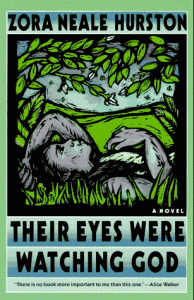
When the protagonist Janie is leaving the home of her first husband, a man she never loved, to follow smooth-talking Joe, the narrator observes: “The morning road air was like a new dress.” The image is striking in that it pulls together two simple but disparate items, air and a dress. This simile gives the reader a completely fresh image which is difficult to do, and the originality is intoxicating. The image also gives the reader a better understanding of Janie’s world. These are not rich people and a new dress is a fine, rare thing. The newness of the dress also points to the possibility that lies ahead for Janie as she leaves what was a stifling relationship. In passing through that morning road air, she is shedding her old clothes and moving into a new life—maybe even a life where she can have new things.
After Janie has spent years of her life as Joe’s wife working in his store and stifling herself when he wants her to, the narrator comments: “The years took all the fight out of Janie’s face. For a while she thought it was gone from her soul.” This reminds the reader that fight was once in her face and that she was a spirited woman. It also implies that submission is a bad thing and that Janie had to give up a part of herself, even if only temporarily, to be with this man. In Janie’s world submission equals being worn down which means that the fighting spirit is something of value.
Local Vernacular
The characters are African American and large portions of the story are set in Florida during a time when segregation was de rigueur. Most of the people are poor and barely scraping by and they are not by and large educated. This is reflected in their dialogue as in this segment from a conversation between two peripheral characters: “‘Ah’m uh bitch’s baby round lady people.’” For a white, educated, northern ear, it takes a concerted effort to completely understand the meaning behind the sentence. A bitch’s baby would be a puppy. Does that mean the character is lagging around behind women like a puppy? And although this imagery is less fresh that the new dress, it is colorful and descriptive. I didn’t necessarily understand everything the characters spoke of during the dialogue in the novel, but Hurston’s way of rendering speech gives insight into the world Janie lives in. I could hear the characters in their native tongue. Because the diction is unusual, I understood more fully the differences between the world in this novel and my world.
Free Indirect Style
Hurston also uses free indirect style, breaking away from the narrative slightly to slip into a comment that sounds like it is coming from Janie. This happens as Janie is considering Tea Cake’s advances: “Must be around twenty-five and here she was around forty…Fact is, she decided to treat him so cold if he ever did foot the place that he’d be sure not to come hanging around there again.” For a moment we are inside Janie’s head and she is sassy. She is judging herself but she is also intrigued by this young man. The sentences are not complete and the syntax is Southern with the “if he ever did” and the “treat him so cold.” This gives the reader a fresh take on the inner workings of Janie, but it is also a bridge between the dialect of the dialogue and the clearer diction of the narrator.
Language is specific to culture and reveals everything that is important about everything worth talking about. For my novel, Polska, 1994, I worked with the language of my characters to denote their backgrounds and their experiences. Language can also be a barrier to understanding. I used some Polish words in my novel and I thought long and hard about each one. In some cases, the Polish was the best possible word because there is not an English equivalent. In others, I wanted the feeling of the Polish word, as with Jacek. I used more Polish in introducing Jacek than I had with other characters because of his intense nationalism. In either case, I rarely translate the word and some understanding will be lost for the non-Polish reader. Hurston’s rich language easily sucked me into her world, but often, especially during passages of dialogue, I was lost in terms of what was going on. I had to spend additional time looking at the language and it took me out of the story and took away from my experience of it. I personally have difficulty understanding novels written in dialect, but I understand is different for every reader. Some readers will find my novel more difficult too. But I hope even in the difficult reads they can love it as much as I loved Their Eyes Were Watching God.
If this review made you want to read the book, pick up a copy of Their Eyes Were Watching God from Bookshop.org. Your purchase keeps indie booksellers in business and I receive a commission.
 Though neither my French nor my understanding of poetry are good enough to honestly rate
  I’ve been thinking about what I could say about The Winter Vault by Anne Michaels that would express how much I loved it. The only way to start is with my own story. Five months ago I married the man I have loved for sixteen years and I thought marriage would be a capstone on our relationship. I didn’t realize our marriage would be the beginning of a new phase of love. Reading about Jean and Avery falling in love, I saw a closeness and intimacy that mirrored ours. I remembered what it was like to fall in love with my husband so long ago and that helped me understand the beauty and fullness of what was happening in this new phase of our relationship. I’ve heard it said that no marriage in literature can be a happy one, and Avery and Jean are confronted with a loss that divides them, but it does not divide the book and the ways they continue to relate and to love are an equally important part of the story.
 In The Law of White Spaces by Giorgio Pressburger, one of the chapters starts with a second person address to the reader. It reads, “Don’t be shocked, dear brother, by the case I’m about to lay before you; don’t be ashamed or disgusted or scandalized, I beg you, by what you are about to learn.” The use of the second person immediately drew me in and made me feel like a part of the story.